- Why a Pool Care Log is Indispensable
- What to Include in Your Water Test Log
- Making Your Pool Care Log Easy and Effective
- Decoding Your Pool Care Log: A Path to Prevention
- Beyond the Numbers: The Broader Benefits
Pool Care Log: the silent guardian of your swimming sanctuary, an indispensable tool for every pool owner striving for crystal-clear, safe water. Far more than just a notebook, a well-maintained log bridges the gap between guesswork and precise maintenance, ensuring your oasis remains a joy rather than a chore. Keeping track of your pool’s vital statistics is the bedrock of proactive pool care, allowing you to anticipate issues, react effectively, and maintain the perfect balance, guaranteeing endless hours of healthy, sparkling fun.
Why a Pool Care Log is Indispensable
Maintaining a swimming pool can sometimes feel like a delicate dance, balancing various chemical parameters to prevent everything from algae blooms to equipment corrosion. Without a structured way to track these elements, pool management can quickly become reactive, leading to bigger problems and higher costs. This is precisely where a dedicated pool care log proves its worth.
Firstly, it’s about health and safety. Unbalanced water can lead to skin and eye irritation, and even foster the growth of harmful bacteria and pathogens. By consistently logging your water test results, you ensure that sanitizers are effective and pH levels are within safe, comfortable ranges, protecting everyone who uses your pool.
Secondly, a detailed log contributes significantly to equipment longevity. Incorrect pH can cause scaling on pool surfaces and equipment or lead to corrosive conditions that damage heaters, pumps, and filters. High calcium hardness can cause cloudiness and deposition on surfaces. Regularly monitoring and adjusting these factors, with a history recorded in your water test log, extends the lifespan of your costly pool infrastructure, saving you money on repairs and replacements.
Thirdly, it offers cost savings beyond equipment. By understanding your pool’s chemical consumption patterns, you can optimize your dosages, reducing chemical waste. Fewer problems mean less need for expensive shock treatments or specialist interventions.
Lastly, and crucially, it’s a powerful troubleshooting and diagnostic tool. When an issue arises – be it persistent cloudiness, algae returning despite treatment, or unusual chemical consumption – your historical data provides invaluable clues. You can quickly pinpoint when a parameter started to drift or identify patterns that lead to recurring problems, making resolution much faster and more efficient.
What to Include in Your Water Test Log
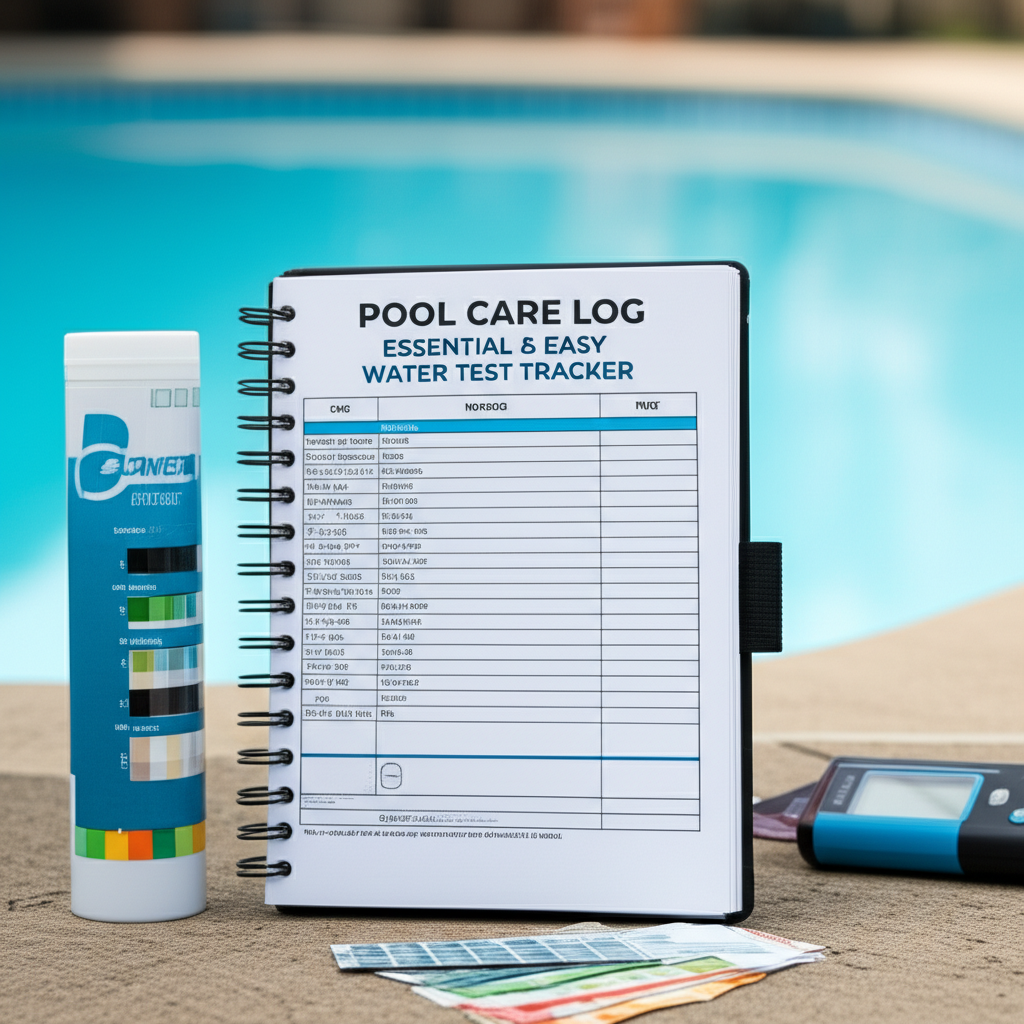
A comprehensive water test log should capture all the critical information needed to assess your pool’s health and track your maintenance interventions. Here are the essential elements:
1. Date and Time: Essential for chronological data and spotting trends.
2. Water Temperature: Can influence chemical effectiveness and evaporation rates.
3. Key Water Parameters:
pH: (Ideal 7.4-7.6) – Impacts comfort and sanitizer effectiveness.
Free Chlorine (FC): (Ideal 1-3 ppm for traditional chlorine, 0.5-1 ppm for saltwater) – Your primary sanitizer.
Total Chlorine (TC): (FC + Combined Chlorine; ideal TC = FC) – Combined chlorine indicates chloramines (spent chlorine).
Total Alkalinity (TA): (Ideal 80-120 ppm) – Buffers pH, preventing swings.
Calcium Hardness (CH): (Ideal 200-400 ppm) – Prevents scaling and corrosion.
Cyanuric Acid (CYA) / Stabilizer: (Ideal 30-50 ppm, higher for saltwater pools) – Protects chlorine from UV degradation.
Other Parameters (as applicable): Bromine, Salt Levels (for saltwater pools), Phosphates, Copper, Iron.
4. Readings: The actual numerical results from your test kit.
5. Actions Taken: What chemicals were added (type and amount), equipment adjustments (e.g., filter backwashed, running time changed), or other maintenance performed.
6. Observations: Notes on water clarity (cloudy, clear, hazy), any unusual odors, presence of algae, or equipment noises.
Making Your Pool Care Log Easy and Effective
The success of your water test log hinges on its ease of use and consistency. There are several formats you can choose from to best suit your preferences:
Physical Notebook/Binder: A simple, reliable option. Purchase a dedicated notebook or print out templates and organize them in a binder. This offers a tactile experience and no reliance on technology.
Printable Templates: Many online resources offer free or paid printable water test log templates with pre-defined sections for all the key parameters. These provide structure and ensure you don’t miss any vital information.
Digital Spreadsheets (e.g., Excel, Google Sheets): For those comfortable with technology, a spreadsheet allows for easy data entry, automatic calculations (if programmed), charting of trends, and cloud accessibility.
* Pool Care Apps: A growing number of mobile applications are designed specifically for pool owners. These often include digital water test logs, chemical dosage calculators, reminders, and even integrate with smart pool devices.
Whichever format you choose, consistency is paramount. Establish a regular testing schedule – daily or every other day for busy pools, 2-3 times a week for less used pools – and stick to it. The more consistently you log data, the more insightful your water test log will become.
Decoding Your Pool Care Log: A Path to Prevention
The true power of your log emerges when you begin to analyze the data. It’s not just about recording numbers; it’s about understanding what those numbers reveal.
Look for trends over time. Is your pH consistently drifting high or low after a certain period? Does your chlorine level drop rapidly after heavy use or exposure to sunlight? Identifying these patterns allows you to make proactive adjustments. For instance, if you notice your stabilizer (CYA) levels gradually creeping up, you know a partial drain and refill might be necessary soon to keep it in check, preventing chlorine lock.
Similarly, if your chemical consumption suddenly increases without a corresponding increase in pool usage, your water test log might signal developing issues like an invisible algae bloom, high phosphates, or a potential contamination problem. By catching these early, you can address them before they escalate into costly and time-consuming headaches. Your log acts as an early warning system, transforming you from a reactive fixer into a proactive pool manager.
Beyond the Numbers: The Broader Benefits
While the primary role of a pool care log is to track water chemistry, its benefits extend further, enhancing the overall pool ownership experience. It provides peace of mind, knowing that your pool is consistently monitored and maintained. It builds your confidence in handling various pool-related tasks as you become more attuned to your pool’s unique needs.
Furthermore, should you ever need to consult a professional pool technician, a detailed history of your water test log readings and actions taken can be incredibly valuable. It provides them with an immediate snapshot of your pool’s health trajectory, significantly aiding in diagnosis and efficient resolution.
In conclusion, adopting a comprehensive Pool Care Log is a simple yet profoundly effective step toward hassle-free pool ownership. It transforms routine maintenance from a guessing game into a precise, informed process. By consistently tracking your water test log data, you ensure a healthy, safe, and inviting swimming environment for years to come, maximizing your enjoyment and minimizing potential problems. Start logging today for a smarter, cleaner, and ultimately, a more relaxing pool experience.