- Why a Pool Care Log is Indispensable for Pool Health
- What to Include in Your Water Test Log
- Making Your Pool Care Log a Habit
A Pool Care Log is not just a fancy accessory for your backyard oasis; it’s an indispensable tool that transforms the often-daunting task of pool maintenance into a structured, manageable, and ultimately effortless routine, especially when it comes to water testing. For many pool owners, the thought of balancing chemicals can be overwhelming. Without a systematic way to track water parameters and treatment actions, you’re often left guessing, reacting to problems after they emerge, rather than proactively maintaining a pristine environment.
Maintaining a swimming pool transcends simply skimming leaves and dumping in chlorine. The true science of pool care lies beneath the surface, within the unseen balance of its chemical composition. pH levels, chlorine concentrations, alkalinity, and calcium hardness are just a few of the critical factors that dictate your pool’s health, safety, and longevity. Regular water testing provides a snapshot of these levels, but it’s the consistent recording of these snapshots in a Pool Care Log that reveals the big picture.
Why a Pool Care Log is Indispensable for Pool Health
Imagine trying to keep a garden flourishing without knowing when you last watered, fertilized, or pruned. It would be a chaotic, reactive process. The same applies to your pool. A dedicated log transforms reactive maintenance into proactive management. Here’s why it’s so vital:
Consistency and Routine: A log establishes a clear routine. By noting down when tests were performed and what chemicals were added, you create a consistent schedule that prevents oversight and promotes regular monitoring.
Trend Tracking: Water chemistry isn’t static. It fluctuates based on bather load, weather, evaporation, and more. A well-maintained `Water Test Log` allows you to observe these trends over days, weeks, and seasons. You can identify patterns – perhaps your pH always creeps up after a hot weekend, or your chlorine drops faster during heavy use. Understanding these trends empowers you to anticipate needs rather than constantly playing catch-up.
Rapid Troubleshooting: When problems arise – like cloudy water, algae bloom, or skin irritation – an accurate history is your best detective. By comparing current readings with past balanced states, you can pinpoint exactly when and possibly why a problem started, leading to quicker and more effective solutions.
Optimizing Chemical Usage: Over-dosing or under-dosing chemicals is common without a reliable record. A log helps you fine-tune your chemical additions, saving money on chemicals and preventing potential damage to your pool’s surfaces or equipment caused by imbalanced water.
Accountability and Communication: If multiple people are involved in pool maintenance, a log serves as a central point of truth. Everyone knows what was done, when, and by whom, preventing duplication of effort or missed steps.
What to Include in Your Water Test Log
To maximize its effectiveness, your Water Test Log should capture key information comprehensively. While specific details might vary, these are the essential elements:
1. Date and Time: Crucial for chronology and understanding environmental factors.
2. Water Temperature: Affects chemical reactions and solubility, and is important for certain test kits.
3. Test Readings:
pH: The measure of acidity/alkalinity.
Free Chlorine (FC): Active sanitizer level.
Total Chlorine (TC): Free chlorine + combined chlorine (chloramines).
Combined Chlorine (CC): TC minus FC. Indicates spent chlorine.
Total Alkalinity (TA): Buffers pH.
Calcium Hardness (CH): Prevents plaster etching or scaling.
Cyanuric Acid (CYA): Stabilizes chlorine from UV degradation.
(Optional) Phosphates, Nitrates, Metals: Depending on your pool’s specific issues or environment.
4. Chemicals Added:
Type of Chemical: (e.g., pH Increaser, Liquid Chlorine, Algaecide)
Quantity Added: (e.g., 1 cup, 1 gallon)
Time Added: To avoid immediate retesting or accidental re-addition.
5. Observations: Note anything unusual – water clarity (clear, hazy, cloudy), unusual odors, presence of algae, equipment issues, heavy rain, or a pool party. This qualitative data can be remarkably helpful for context.
6. Actions Taken: Beyond chemical additions, note if you backwashed, cleaned the filter, vacuumed the pool, or performed any other maintenance tasks.
Making Your Pool Care Log a Habit
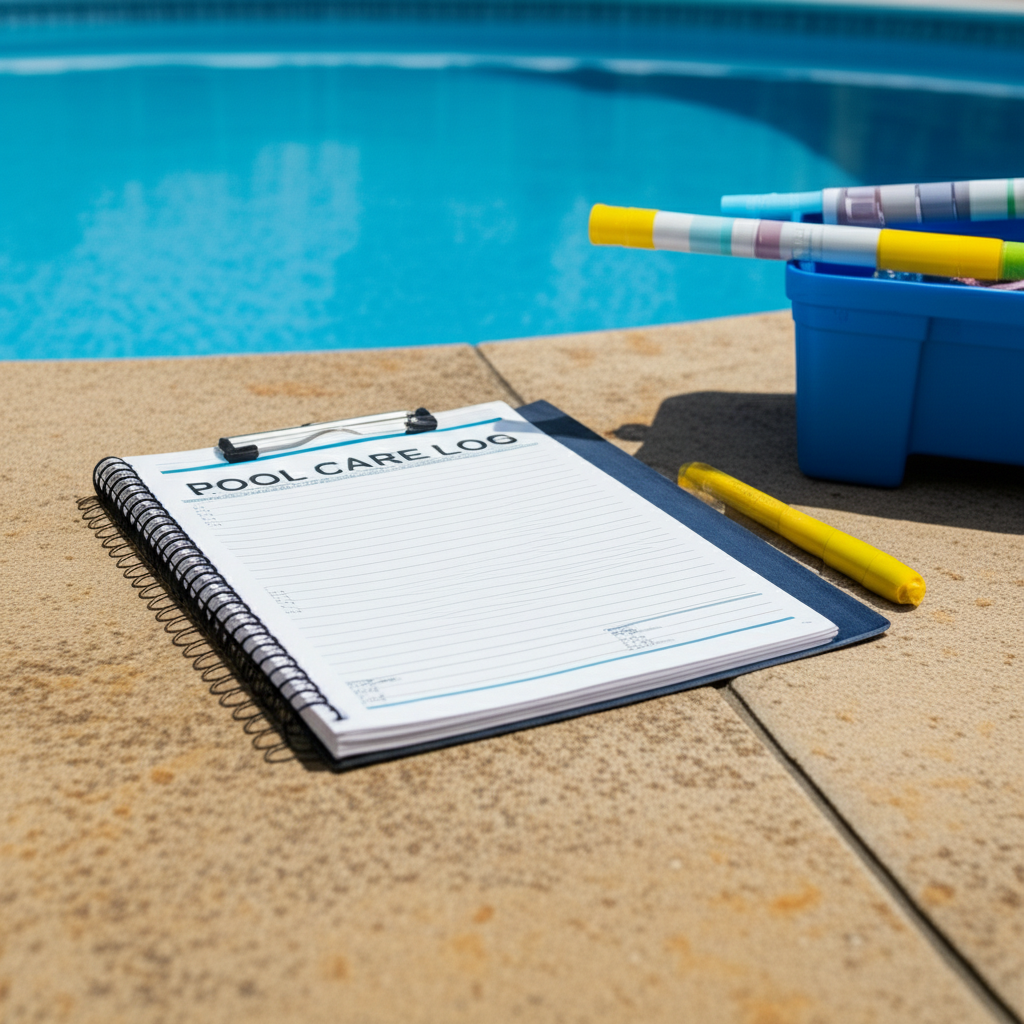
Integrating a Pool Care Log into your routine is simpler than you might think. Choose a format that suits you best: a dedicated waterproof notebook, a laminated checklist, a spreadsheet on your computer, or even a specialized pool care app. Keep your chosen log near your testing kit for convenience.
Start by committing to testing and logging at least twice a week during peak season, and once a week during cooler months. Set reminders on your phone or mark it in your calendar. Over time, logging your pool’s data will become a natural part of your maintenance rhythm.
In essence, a well-maintained Pool Care Log transforms pool maintenance from a series of educated guesses into a data-driven, precise science. It provides peace of mind, ensures crystal-clear, healthy water, and ultimately protects your investment in your backyard oasis for years to come.