- Why Consistent Pool Water Testing is Non-Negotiable
- Key Parameters for Optimal Pool Water Chemistry
- Essential Tools for Pool Water Testing
- Water Test Kits (Liquid Reagent Kits)
- Test Strips
- Liquid Test Kits (Individual Reagents)
- Mastering Your Pool Water Testing Routine
- The Role of Professional Testing
Pool water testing is the cornerstone of maintaining a healthy, sparkling, and inviting swimming environment. Far more than just guessing, regular and accurate testing ensures that your pool water is not only visibly clean but also chemically balanced, protecting both swimmers and the pool’s infrastructure. Neglecting this crucial step can lead to a cascade of problems, from irritating skin and eyes to costly equipment damage and the unsightly growth of algae.
Why Consistent Pool Water Testing is Non-Negotiable
Maintaining pristine pool water goes beyond aesthetics; it’s fundamentally about health, safety, and prolonging the life of your investment.
1. Ensuring Swimmer Safety and Health: Unbalanced water can harbor bacteria, viruses, and other pathogens, leading to recreational water illnesses. Incorrect pH levels can cause skin irritation, red eyes, and even damage hair. Regular testing allows you to maintain optimal sanitizer levels, effectively neutralizing harmful contaminants.
2. Protecting Your Pool Equipment: Water that is too acidic (low pH) can corrode metal parts, including heaters, pumps, and ladders, leading to expensive repairs or replacements. Conversely, water that is too alkaline or has high calcium hardness can cause scaling on surfaces, filters, and inside pipes, reducing efficiency and lifespan.
3. Preventing Algae and Cloudiness: Proper chemical balance prevents the proliferation of algae, keeping your water clear and appealing. Imbalanced water, even with adequate sanitizer, can become cloudy, making it uninviting and difficult to see the bottom.
4. Optimizing Chemical Usage and Costs: Guessing chemical dosages often leads to overuse or underuse. Overdosing wastes money and can create uncomfortable swimming conditions, while underdosing leaves your pool vulnerable. Accurate testing allows for precise chemical adjustments, saving you money in the long run.
Key Parameters for Optimal Pool Water Chemistry
To achieve pristine water, you need to monitor several critical parameters:
pH: Measures how acidic or basic your water is. The ideal range is 7.4-7.6 (some sources extend to 7.2-7.8). Too low, and water becomes corrosive; too high, and chlorine becomes ineffective, leading to scale formation.
Free Available Chlorine (FAC): This is the chlorine actively working to sanitize your pool. The recommended range is 1-3 ppm (parts per million), though some experts suggest 2-4 ppm. Maintaining this level is vital for killing bacteria and algae.
Total Alkalinity (TA): Acts as a buffer to prevent rapid fluctuations in pH. The ideal range is 80-120 ppm. Low alkalinity makes pH hard to manage; high alkalinity can lead to cloudy water and scale.
Calcium Hardness (CH): Measures the amount of dissolved calcium in your water. The ideal range is 200-400 ppm. Low calcium can cause corrosion of plaster and metal components as the water seeks calcium from surfaces. High calcium can lead to scaling.
Cyanuric Acid (CYA) / Stabilizer: Protects chlorine from degradation by UV rays. The ideal range is 30-50 ppm (up to 80 ppm for saltwater pools). Too low, and chlorine dissipates quickly; too high, and chlorine activity is inhibited.
Essential Tools for Pool Water Testing
To accurately assess these parameters, several reliable tools are available:
Water Test Kits (Liquid Reagent Kits)
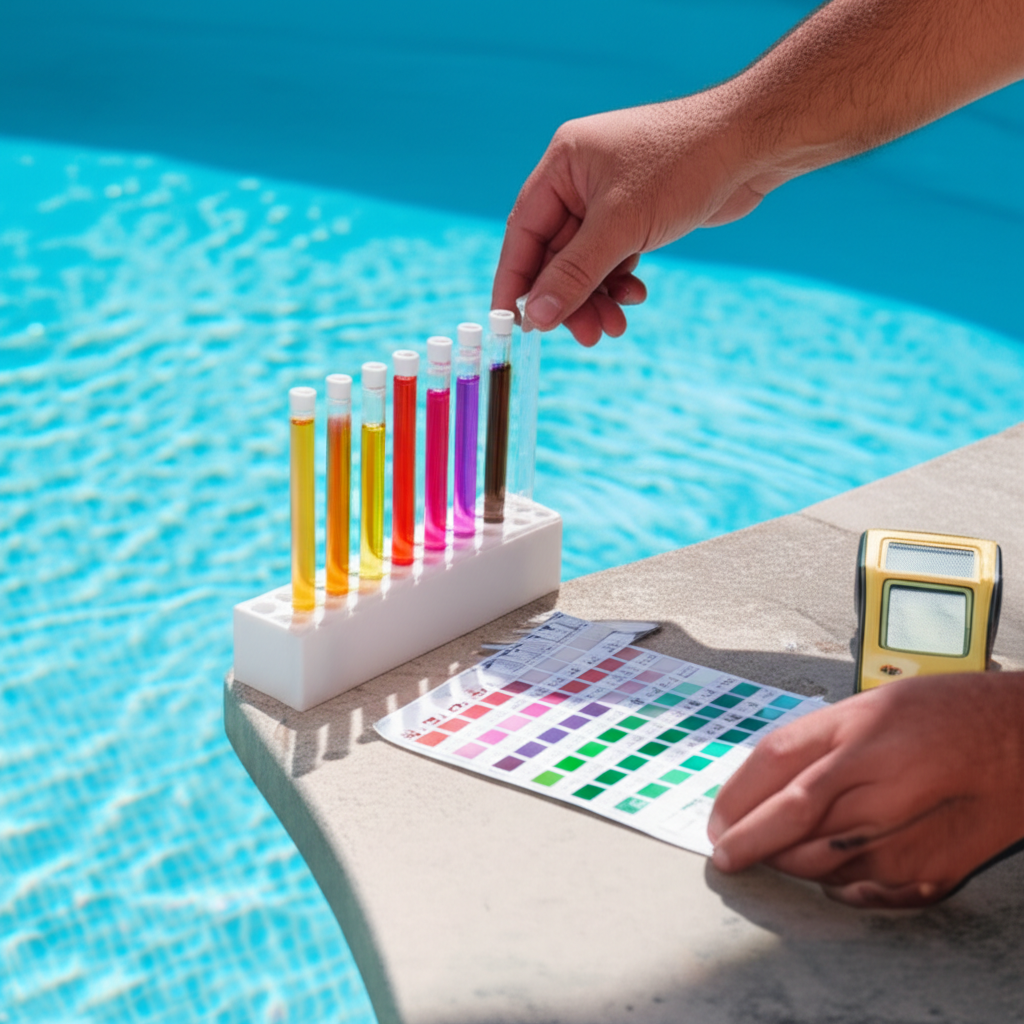
Often considered the gold standard for home pool owner testing, water test kits utilize liquid reagents that you add to a water sample. These kits typically come with small vials, a color-matching chart, and specific liquid chemicals for measuring pH, chlorine, and often alkalinity and calcium hardness.
Pros: Generally offer higher accuracy than test strips, especially for critical parameters like pH and chlorine. They can measure a wider range of parameters, making them comprehensive.
Cons: Can be more time-consuming and require a bit more attention to detail. Reagents have expiration dates and must be stored properly.
Test Strips
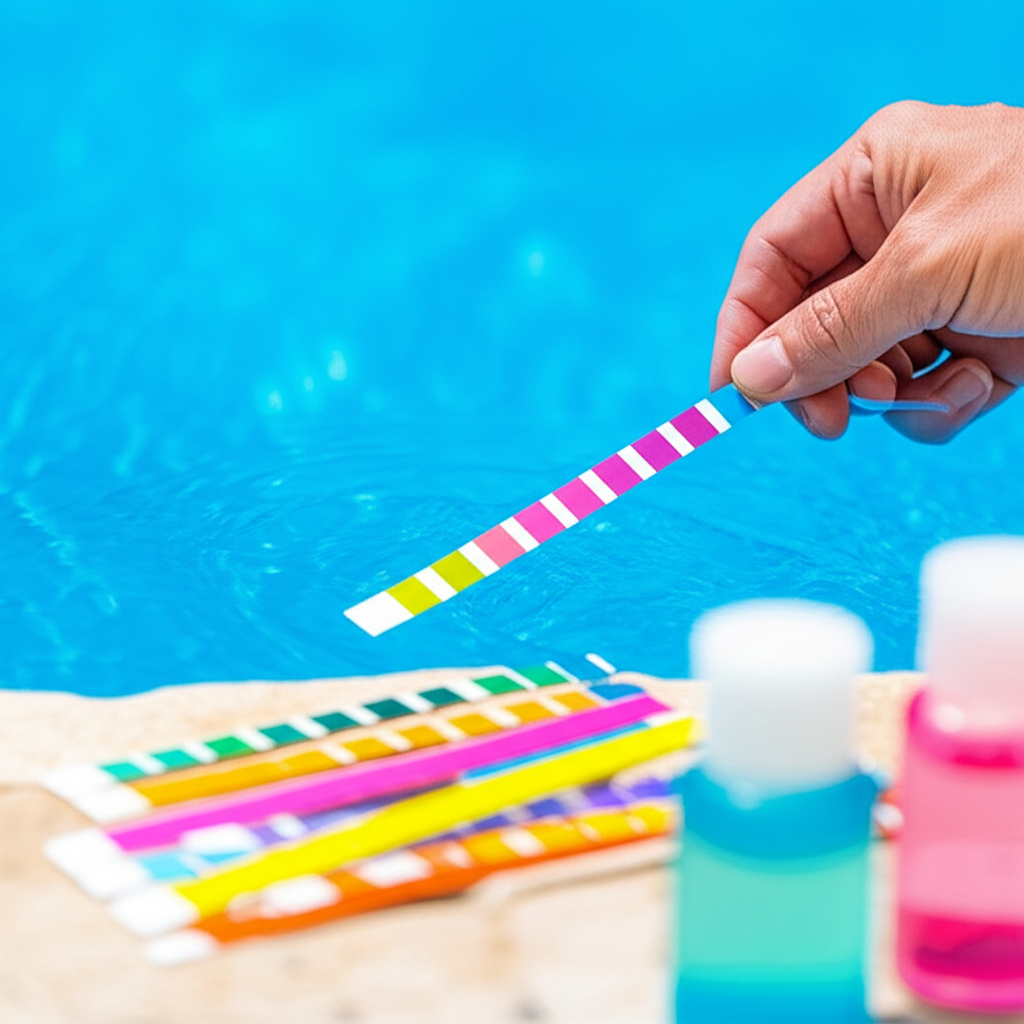
Test strips are perhaps the most convenient and widely used method for routine pool water testing. They are small paper or plastic strips with pads treated with chemicals that change color when dipped in pool water. You then compare the colors on the strip to a color chart on the bottle.
Pros: Incredibly fast and easy to use (“dip and read”). They are affordable and readily available, making daily or twice-daily checks hassle-free.
Cons: Less precise than liquid tests and can be prone to human error in color matching. Their accuracy can degrade if exposed to moisture or extreme temperatures. They typically measure fewer parameters than comprehensive liquid kits.
Liquid Test Kits (Individual Reagents)
While often included as part of larger water test kits, individual liquid test reagents for specific parameters can also be purchased. For instance, DPD test kits for free and total chlorine, or phenol red for pH. These often involve adding drops to a sample and viewing a color change.
Pros: Provide very reliable and accurate readings for the specific parameters they are designed for. They are often favored by professionals for the accuracy needed for sensitive adjustments.
* Cons: Can be more involved and time-consuming, requiring careful measurement of drops. Each parameter may require a separate kit or set of reagents.
Mastering Your Pool Water Testing Routine
Consistency and correct procedure are key to effective pool water testing:
1. Frequency: Test chlorine and pH daily or every other day, especially during heavy use or hot weather. Total alkalinity, calcium hardness, and cyanuric acid can typically be tested weekly or bi-weekly.
2. Sample Collection: Collect your water sample away from return jets or skimmers, and at least elbow-deep (about 18 inches) to get a representative reading.
3. Read Carefully: For test strips, follow the dip and wait time exactly. For liquid kits, count drops precisely and compare to the color chart in good, natural light.
4. Store Kits Properly: Keep all test kits and reagents in a cool, dry place, away from direct sunlight, and ensure lids are tightly sealed to preserve accuracy.
5. Interpret and Act: Understand what each parameter means. If a reading is off, consult a pool chemistry guide or your local pool professional for the correct chemical adjustments (e.g., adding pH increaser/decreaser, alkalinity increaser, etc.). Always add chemicals slowly and allow time for them to mix before retesting.
The Role of Professional Testing
While home kits are excellent for routine maintenance, it’s wise to have your water professionally tested at a pool store or by a service technician periodically – perhaps monthly or at the beginning and end of the swimming season. Professional labs can test for a broader range of parameters, including phosphates, metals, and TDS (Total Dissolved Solids), which can highlight underlying issues not caught by standard home kits.
In conclusion, neglecting pool water testing is a gamble with your pool’s health and your family’s safety. By consistently utilizing water test kits, test strips, or liquid test agents, you empower yourself to keep your pool water perfectly balanced, ensuring a consistently clean, safe, and enjoyable swimming experience for everyone.