- Why Precision in Pool Pump Sizing Matters
- Understanding Key Metrics: Flow Rate and Total Dynamic Head
- The Fundamentals of Proper Pool Pump Sizing
- Variable Speed Pumps: The Smart Choice for Effortless Flow Rate
- Avoiding Common Mistakes
Pool Pump Sizing is arguably one of the most critical decisions a pool owner will ever make, directly impacting everything from water clarity and chemical consumption to energy bills and the lifespan of their equipment. Getting it right ensures an effortless flow rate, providing optimal performance without unnecessary strain or expense. Conversely, an improperly sized pump can lead to a host of problems, from murky water and algae blooms to premature wear and tear on your entire pool system.
Why Precision in Pool Pump Sizing Matters
Many pool owners mistakenly believe that ‘bigger is better’ when it comes to pumps. In reality, an oversized pump can be just as detrimental as an undersized one, if not more so. An oversized pump will waste energy by moving water too quickly, potentially damaging sensitive equipment like filters and heaters, and even eroding plumbing over time. It can also lead to ‘channeling’ in sand filters, where water carves paths through the media instead of being thoroughly filtered. An undersized pump simply won’t circulate and filter the water adequately, leading to poor water quality and increased chemical usage. The goal, therefore, is to find the perfect balance – a pump that matches your pool’s unique needs and system components.
Understanding Key Metrics: Flow Rate and Total Dynamic Head
To achieve expert, effortless flow, two primary metrics must be understood:
1. Flow Rate (GPM): Measured in Gallons Per Minute (GPM), this is the actual volume of water your pump can move through your system. It’s the central figure we need to determine.
2. Total Dynamic Head (TDH): This represents the total resistance the water encounters as it travels through your pool’s plumbing and equipment. Factors contributing to TDH include pipe diameter, length, bends, valves, the type of filter, heater, and any elevation changes. Pumps are rated by how much GPM they can deliver at various TDH levels.
The Fundamentals of Proper Pool Pump Sizing
The process of correctly sizing a pool pump involves several steps:
1. Calculate Your Pool’s Volume:
First, determine the total volume of water in your pool in gallons.
Rectangular Pools: Length x Width x Average Depth x 7.48 = Gallons
Circular Pools: π x Radius^2 x Average Depth x 7.48 = Gallons
Oval Pools: Length x Width x Average Depth x 5.9 = Gallons (approximate)
2. Determine Your Desired Turnover Rate:
The turnover rate is how long it takes for the entire volume of your pool’s water to pass through the filter system. For residential pools, a common recommendation is an 8-10 hour turnover rate. This ensures the water is adequately filtered at least 2-3 times per day during the pump’s operating hours. An 8-hour turnover rate is often considered ideal.
3. Calculate the Required Flow Rate (GPM):
Using your pool’s volume and desired turnover rate, you can now calculate the minimum GPM your system needs.
Required GPM = (Pool Volume in Gallons / Desired Turnover Time in Minutes)
Example: For a 20,000-gallon pool with an 8-hour turnover:
8 hours = 480 minutes
20,000 gallons / 480 minutes = 41.67 GPM
4. Identify Your Filter’s Maximum Flow Rate:
This is a critical, often overlooked, limiting factor. Every pool filter (sand, cartridge, DE) has a maximum GPM rating specified by the manufacturer. Operating a pump above this rating can damage the filter, reduce its efficacy, and even compromise water quality. Your desired pump’s actual flow rate must never exceed your filter’s maximum GPM. If your calculated GPM is higher than your filter’s maximum, you must size your pump to operate at or below the filter’s limit. You might also want to consider upgrading your filter.
5. Estimate Your Total Dynamic Head (TDH):
This is the most complex part and is often where professional input is invaluable. TDH accounts for all resistance in your plumbing system. Factors to consider include:
Pipe length and diameter (smaller pipes and longer runs increase resistance).
Number of elbows, tees, and valves.
Type of filter, heater, and other equipment (each adds its own resistance).
Vertical lift (how high the water needs to be pumped).
There are charts and calculators available that can help you estimate TDH, but an accurate calculation requires understanding every component in your system.
6. Select the Right Pump:
Once you have your required GPM (limited by your filter’s maximum) and an estimate of your TDH, you can consult pump performance curves. These charts, provided by manufacturers, show how much GPM a specific pump can deliver at various TDH values. You want to find a pump whose performance curve intersects your required GPM at your estimated TDH.
Variable Speed Pumps: The Smart Choice for Effortless Flow Rate
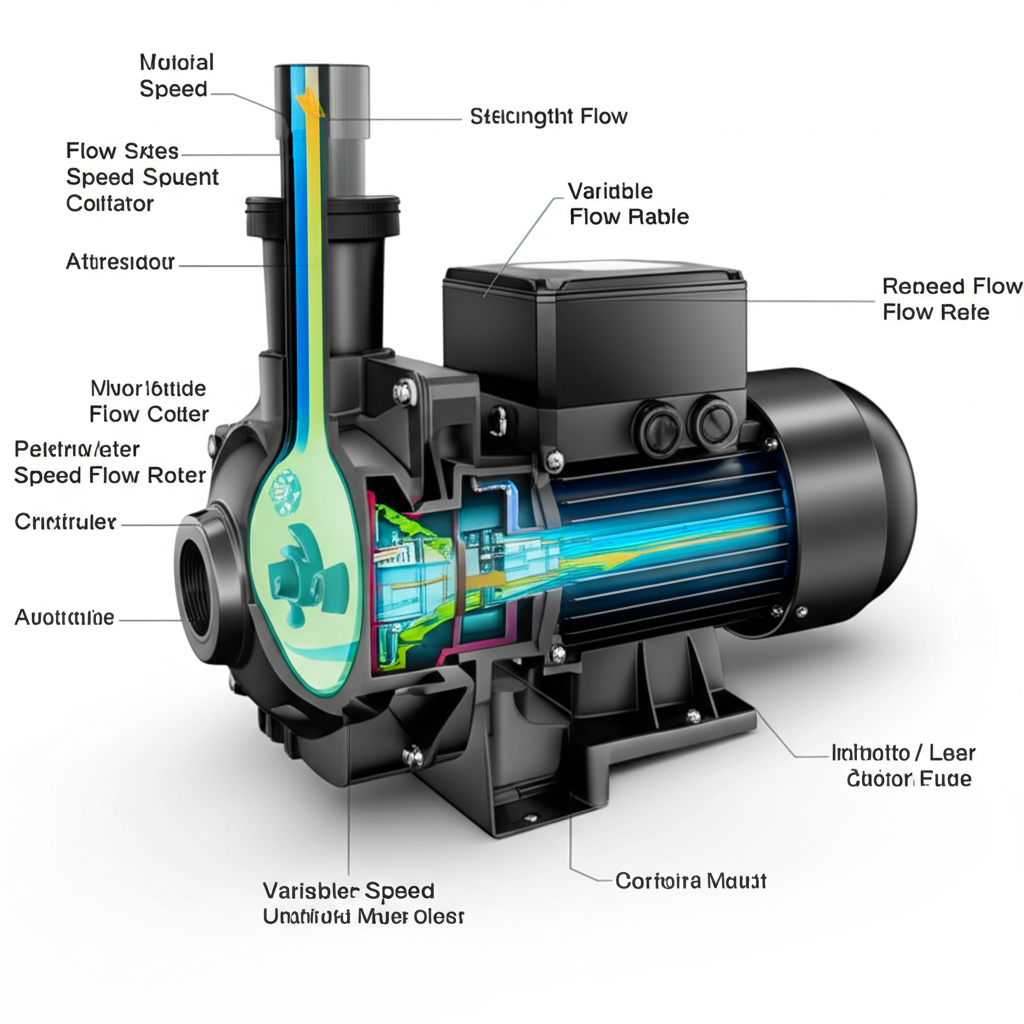
While single-speed and dual-speed pumps are still available, variable speed pumps (VSPs) have become the industry standard for their unparalleled efficiency and flexibility. A VSP allows you to precisely control the motor’s RPM, which directly impacts the flow rate. This means you can run the pump at lower, more energy-efficient speeds for continuous filtration, saving a significant amount on electricity bills – often offsetting the higher initial cost within a couple of seasons. VSPs also reduce noise and wear on equipment, ensuring an expert, effortless flow rate tailored to your pool’s specific needs throughout the day.
Avoiding Common Mistakes
Oversizing: Leads to wasted energy, increased wear on plumbing and filter, and potential equipment damage.
Undersizing: Results in poor water quality, algae problems, and an overworked pump that shortens its lifespan.
Ignoring Filter Specs: Never exceed your filter’s maximum GPM.
* Not Accounting for All Components: Every fitting, valve, and piece of equipment adds resistance (TDH).
Proper Pool Pump Sizing is not just about moving water; it’s about optimizing your entire pool’s ecosystem for health, efficiency, and longevity. By understanding and applying the principles of GPM and TDH, and by considering modern solutions like variable speed pumps, you can achieve an effortless flow rate that keeps your pool sparkling clean and your operating costs low for years to come. When in doubt, consulting with a qualified pool professional can provide the expert guidance needed to make the best decision for your aquatic haven.